

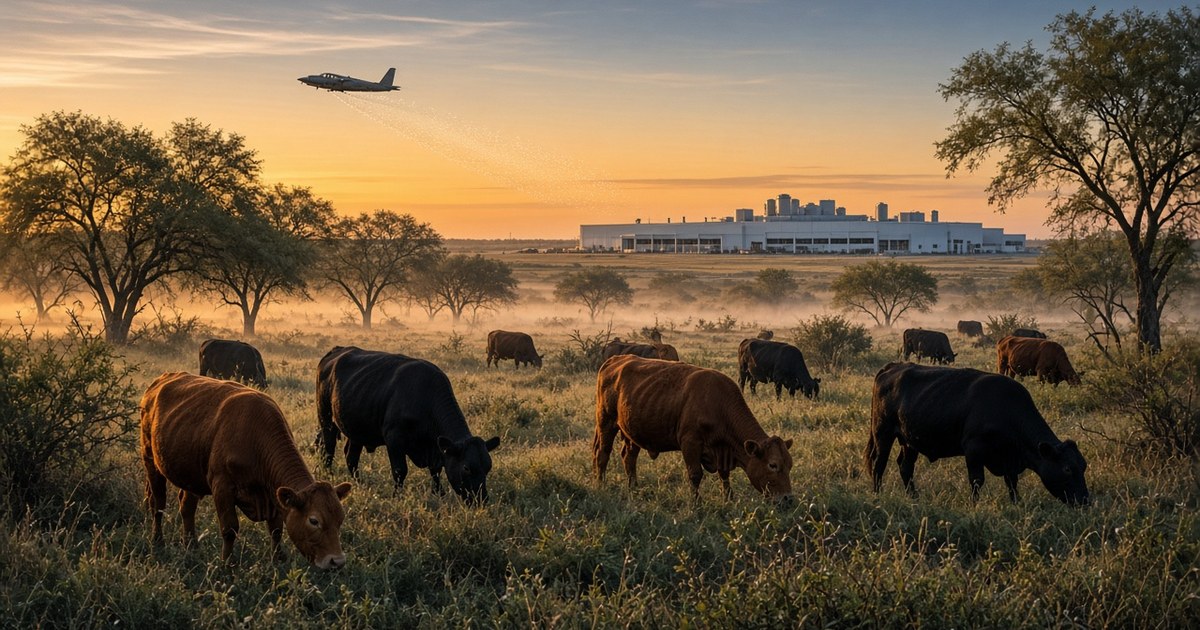
On a stretch of old runway outside Edinburg, Texas, the USA is building something it has not had in decades: its own factory for sterile screwworm flies. On November 10, 2026, Agriculture Secretary Brooke Rollins said USDA will start hiring 228 people to run it, with a job fair in McAllen on November 17–19.
The timing is not an accident. The New World screwworm, a fly that lays its eggs in open wounds so its larvae can eat living flesh, is back on USA soil for the first time since it was wiped out here in the 1960s. Texas confirmed its first case in a Zavala County calf on June 3, 2026. By November 12, USDA had confirmed 130 animal infestations across Texas, New Mexico and Arizona, and the count had jumped nearly 65% in the first twelve days of November alone, according to Texas Public Radio’s tracker of USDA data.
What USDA is building at Moore Air Base
- Location: Moore Air Base in Edinburg, in Hidalgo County, a site USDA chose for its existing infrastructure and its closeness to the U.S.-Mexico border.
- Price tag: $750 million, as announced by Gov. Greg Abbott and Secretary Rollins in August 2025. KRGV has since reported the project at nearly $800 million.
- Builder: Mortenson Construction, under a contract overseen by the U.S. Army Corps of Engineers, announced March 9, 2026. Ground was broken April 17, 2026.
- Schedule: USDA now says construction will be done in April 2027, pulled forward from a November 2027 target after the agency committed to double shifts. Rollins says the plant will open “nearly five years ahead of schedule.”
- Output: about 100 million sterile flies a week once production starts in 2027, rising to roughly 300 million a week at full capacity.
- Jobs: 228 federal positions, posted on USAJobs.gov, with interviews at the Embassy Suites McAllen Convention Center, 8 a.m. to 8 p.m. Central each day of the November 17–19 event.
The Corps’ Fort Worth District reported on October 19 that crews had poured about 10,200 cubic yards of concrete and that steel on the first production building was about 75% installed.
USDA calls it the first USA-based sterile fly production facility in this fight. Right now every sterile fly dropped over Texas is raised somewhere else: about 100 million a week at the COPEG plant in Panama, plus a converted fruit fly plant in Metapa, Mexico, that opened in June 2026 and is still ramping toward 100 million a week. USDA put $21 million into the Mexican plant. Moore Air Base already has a smaller job: an $8.5 million dispersal center, opened February 9, 2026, that takes in flies from Panama and Mexico and gets them out over the range. It can handle up to 100 million flies a week, but it produces none of its own.
In its August 2025 plan, USDA said the new production plant would end the USA’s reliance on foreign facilities for sterile flies. That is the Made in USA story here: a pest that threatens the USA cattle herd, beaten with flies raised, sterilized and released by USA workers on USA soil.
How a sterile fly stops a flesh-eating pest
The trick is a quirk of screwworm biology: a female mates only once. Raise millions of males, sterilize them, release them over infested country, and every wild female that pairs with one lays eggs that never hatch. Keep it up long enough and the population collapses. The released flies cannot produce larvae, so USDA says they pose no risk to animals or people.
Today that sterilization is done with radiation, traditionally from cobalt-60. On November 11, Texas A&M AgriLife Research reported early success with electron-beam sterilization, which runs on electricity instead of a radioactive source and cuts treatment time from minutes to seconds. Lead researcher Suresh Pillai said, “We’ve demonstrated that eBeam can do what cobalt-60 does against the New World screwworm.” The work is one of 40 projects that share $105 million from USDA’s screwworm Grand Challenge.
Texas beat this fly once, on this same airfield
This is the part of the story that should make every Texas rancher sit up. The sterile insect technique was worked out by USDA entomologists Edward Knipling and Raymond Bushland. Knipling came up with the sterile-male idea at USDA’s Menard, Texas, lab in 1937, and Bushland proved in the early 1950s that sterile males could be produced. The USDA research lab in Kerrville now carries both their names.
When the Southwest eradication campaign began in February 1962, the sterile flies came from a plant set up at former Moore Air Base near Mission. Much of the money came from ranchers and sportsmen themselves through the Southwest Animal Health Research Foundation, which raised more than $1.8 million by the end of 1962. According to USDA’s National Agricultural Library, the plant was making up to 150 million sterile flies a week by 1966, the year the USA was declared free of native screwworms.
So the 2027 plant goes up on the same base that produced the flies for the 1960s campaign, more than 60 years later.
Why this matters to ranchers and to anyone who buys beef
The screwworm is not a food safety problem. USDA says the larvae do not infest meat, and the Texas Animal Health Commission notes that federal meat inspectors would catch any infested animal at slaughter. The danger is to live animals, and the bill lands on ranches:
- A small herd with no room for losses. USDA counted 86.2 million cattle and calves in the USA on January 1, 2026. Bloomberg reported that this keeps the herd at a 75-year low, keeping beef prices high.
- Texas has the most at stake. USDA’s own economic analysis says a repeat of the 1976 Texas outbreak would cost Texas livestock producers about $732.6 million and the state economy about $1.83 billion in 2024 dollars. Texas A&M AgriLife economists estimate a large outbreak could cost the state’s cattle industry $2.1 billion and threaten its $9 billion hunting and wildlife industry.
- Cattle movement is restricted. As of November 12, animal movement controls were in place in parts of 21 Texas counties, from Starr and Zapata on the border to Nolan, Fisher and Scurry farther north. The Texas Animal Health Commission counts 76 Texas premises in 25 counties with at least one confirmed detection.
- Imports from Mexico are reopening in stages. After ports were shut to Mexican cattle in 2025, USDA has reopened Douglas, Arizona (August 24, 2026), Santa Teresa, New Mexico (September 24) and Columbus, New Mexico (October 26), with Nogales, Arizona, set for November 30. Pro Farmer, citing Bloomberg, reported that some ranchers worry the reopening came too soon, with about 1,500 active cases in Mexico.
For shoppers who look for the Product of USA label on beef, the logic is simple. That label only means something if there are healthy USA-born, USA-raised cattle to put behind it, and protecting the herd at home is how that supply is kept.
Hear it from a cattleman on Monday
Pete Petropoulos, a cattleman, oilman and screwworm expert, will join Adam Reiser on Made in USA Mondays this Monday, November 16, 2026, at 10:30 a.m. ET. (Disclosure: Petropoulos is listed as a director of Made in USA Inc., which Adam Reiser chairs, in the company’s August 2025 SEC filing.) Expect the questions ranchers are actually asking: whether the 2027 plant is coming fast enough, what the Mexican cattle reopening means for the border, and what to watch for in a herd right now.
Watch live on YouTube at youtube.com/@madeinusainc and follow @REISERIAM on X for the link.
If you raise animals in the Southwest: check them daily for draining wounds or maggots and report anything suspicious to your state veterinarian or through Screwworm.gov.
Sources & credit
Primary source: USDA: “USDA Begins Hiring for Nation’s Largest Facility to Combat New World Screwworm”, November 10, 2026.
USDA: sweeping plans to protect the USA from New World screwworm (Aug. 15, 2025); Mortenson construction contract (Mar. 9, 2026); groundbreaking (Apr. 17, 2026). USDA APHIS: dispersal facility completion (Feb. 9, 2026); current NWS status and port reopenings; NWS historical economic impact report. USDA NASS: Cattle report (Jan. 30, 2026). USDA ARS: Knipling-Bushland lab history. National Agricultural Library: “STOP Screwworms” 1958–1969.
Additional reporting: Office of the Texas Governor: $750 million facility announcement; U.S. Army Corps of Engineers Fort Worth District: construction update (Oct. 19, 2026); KRGV: “Sterile screwworm fly facility in Edinburg to be completed sooner” (Oct. 5, 2026); Texas A&M AgriLife Today: eBeam sterilization research (Nov. 11, 2026); Texas Public Radio: New World screwworm tracker (updated Nov. 12, 2026); Texas Animal Health Commission: NWS situation page; Pro Farmer: “Screwworm cases continue to grow”; Bloomberg: “US Cattle Herd Stays at 75-Year Low”; SEC: Made in USA Inc. Form 8-K (Aug. 2025).