
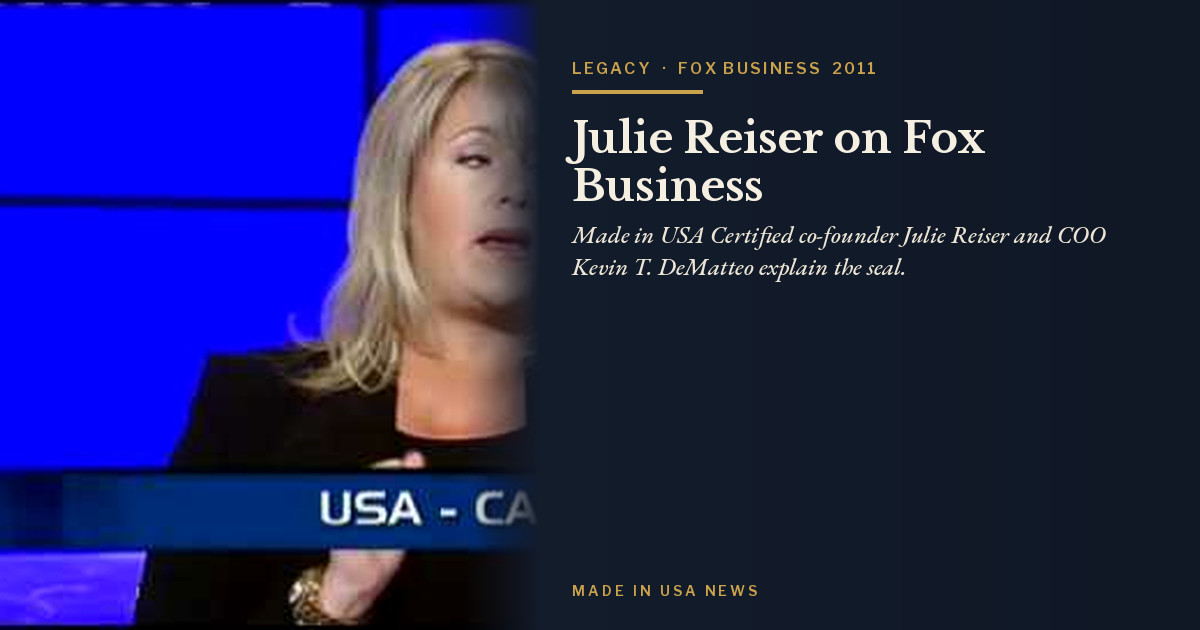
In January 2011, Made in USA Certified co-founder and president Julie Reiser and chief operating officer Kevin T. DeMatteo went on Fox Business News Live from the network’s New York studio to explain what it takes to put a Made in USA Certified seal on a product. They appeared on a segment of “The USA Cache” with hosts Tracy Byrnes and Chris Cotter.
DeMatteo told the hosts that the company certifies product lines, not companies, and that it does so with a supply-chain audit of a product’s component parts. The labor and assembly, he said, have to be in the United States, and he described the audit as following Federal Trade Commission guidance on Made in USA claims. On air, he also used a shorthand of “70% or better” of those component parts having a United States country of origin. The Commission’s unqualified standard is that a product advertised as Made in USA must be all or virtually all made in the United States; the 70% figure is what was said on the program, not a quotation from the FTC.
Julie Reiser said shoppers were connecting job losses to the loss of manufacturing, and that people were reading labels more carefully after import-safety scares, including Chinese drywall and children’s toys. “I don’t believe that we can have a strong economy without a strong U.S. manufacturing base,” she said. “We can’t just be a service country.” She also described starting a magazine that told the stories of USA manufacturers, and then building a third-party seal, in the tradition of certified organic, UL listing and the Good Housekeeping seal, to check the Made in USA claim itself. Near the end of the segment, the hosts held up the seal and pointed viewers to the company’s website, usa-c.com.
The clip is an early, on-the-record statement of the Certified program: a supply-chain audit, a visible seal, and a way for shoppers to tell a checked Made in USA claim from a stamp on a box. Fox Business aired the interview; Made in USA Certified later posted the segment on YouTube.
The video
Credit: MADE in USA CERTIFIED Fox Business Video, posted January 31, 2011, on the Made in USA Certified channel. The interview aired on Fox Business News Live. The same clip is also listed on Made in USA News’ Videos page.
Transcript
The text below is from the video’s automatic captions, lightly cleaned for punctuation and speaker labels. The caption track misspelled several names (“Julie Riser,” “Kevin Deo,” “Kevin D Mato,” and a garbled host name). The spellings used here — Julie Reiser, Kevin T. DeMatteo, Tracy Byrnes and Chris Cotter — come from Made in USA News’ own video archive and contemporary company materials. Captions also rendered the website as “USA dc.com”; it is usa-c.com. Automatic captions can still misspeak words.
Host: That Made in the USA label can’t just be stamped on any product. There are actually real qualifications behind it. And here to talk about what certifies a product to make that claim is Julie Reiser and Kevin DeMatteo, owners of Made in USA Certified, Inc. Thank you both for being with us.
DeMatteo: What we do is we reach out to U.S. manufacturers, they reach out to us, and they want to become certified. It’s a relatively simple process, although a rigorous process. We do something that no other company does in the United States, and we perform a rigorous supply chain audit on the company product. We don’t certify a company. We certify its product lines. And in so doing, it’s a process that essentially is a supply chain audit of the component parts of that product.
On raw materials, DeMatteo said, “Absolutely, everything.” He added that there are two basic components to the process, and that for the most part it follows guidelines established by the FTC: “The FTC says basically two things in their 40 or 50 pages. They say that 100% of the labor or the assemblage of that product must be here in the United States. When it comes to the component parts of that, there’s no real line in the sand, but it’s essentially 70% or better of those component parts with USA as the country of origin.”
Reiser: I think that there is a fundamental shift happening in America right now because of our economy and because Americans are unable to find jobs. I disagree with your previous guest saying that the United States is just going to become a service industry only. I don’t believe that we can have a strong economy without a strong U.S. manufacturing base. We can’t just be a service country. I think finally Americans are making the connection between U.S. jobs and our economy. Americans can’t find jobs. They’re losing their homes, and it comes down to the fact that there are no jobs. Why are there no jobs? Well, we have no manufacturing. So I think that they’re making that connection. People are reading labels more and more. They’re looking for labels like certified organic, country of origin. I think it is more and more important to consumers, and they are making that connection, which is key.
Asked about import-safety scares, Reiser said, “Absolutely. I mean, very dangerous things have gone on, between the Chinese drywall, between the toys that you buy for your kids that you think you’re giving them a fun little toy, and the next thing you know their esophagus is ripped open. I mean, that kind of stuff should not be happening in America at all. And currently right now there is no national standard to monitor that type of stuff. So we hope to become the national standard of being able to go in and audit these companies, verify that claim of Made in USA, give them our seal as a stamp of approval so consumers can stay safe, their families can stay safe, and keeping companies honest.”
DeMatteo, on how the program differs from other groups: “What we have and what we’ve established is a proprietary process. Yes, there are other organizations out there. There are a multitude, a plethora of websites that have cropped up in the last couple of years, proudly claiming to be flag-waving patriotic manufacturing organizations. What we have done is, by establishing a process, we really have the process down. There are no other organizations that do what we do. We roll up our sleeves. We do in essence a forensic study on that supply chain.”
Reiser, on why the company was started: “Years ago my husband and I started a company called Made in USA Magazine, and we were printing a magazine that went around and told the stories of the American manufacturer — kind of the all-American story. Some of these companies that we have in the United States are so great. They go back to the late 1800s, early 1900s. They’re still family-run businesses. They employ whole towns and cities. Really, it is the American story. Well, as we were printing that magazine and we saw those companies going out of business as outsourcing really took hold of our country, it occurred to us, well, how do we really know that that claim is true? I mean, you can stamp it on your product, but how do you know that’s true, and who’s doing the checking? So, inspired by certified organic and UL listing and the Good Housekeeping Seal of Approval, we came up with this concept to verify that claim.”
The hosts closed by holding up the seal and giving the website as usa-c.com.