

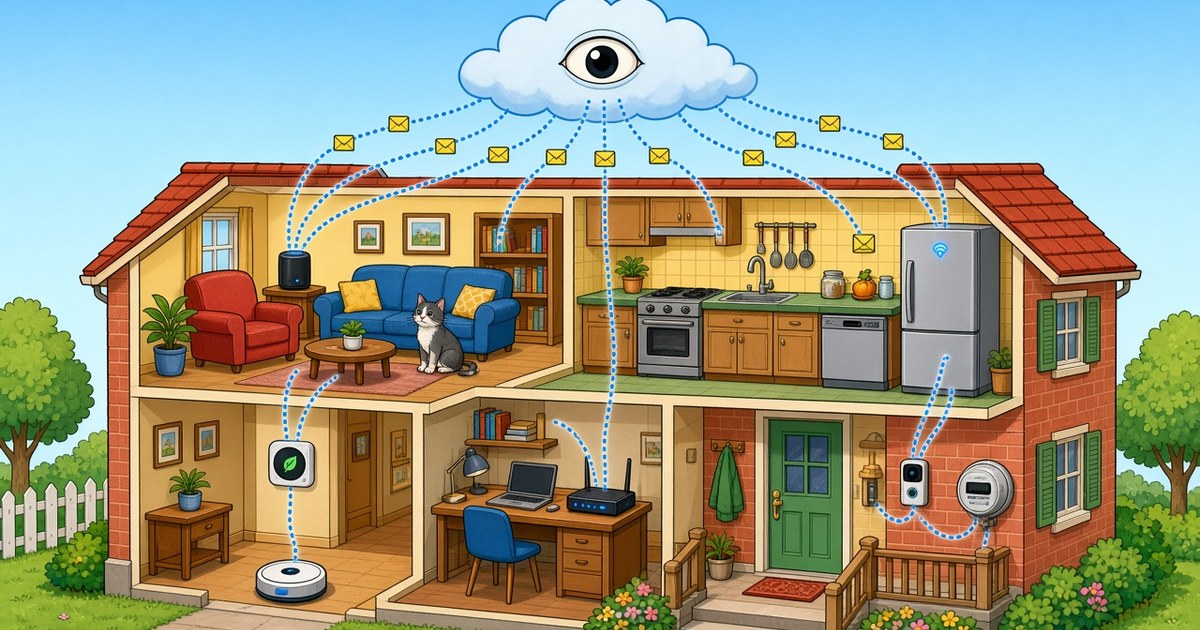
Welcome back to “Who’s Spying on You?” In Part 1 we pulled the lab coat off the word “telemetry.” In Part 2 we went out to the driveway and found out when your car started spying. This time we come inside, close the front door and take a walk through your own house, room by room. The question is the same: who’s listening, who’s watching, and who’s keeping the tape?
Your great-grandparents’ house had a meter reader who came by once a month, a doorbell that went “ding-dong,” and a radio that only talked. It didn’t talk back, and it sure didn’t take notes. Today the thermostat, the meter on the side of the house, the vacuum, the fridge, the doorbell and the speaker on the kitchen counter can all be connected to somebody else’s computer. That’s the “telemetry” we talked about in Part 1, just wearing an apron.
Your home used to be your castle. Now it’s a sensor network with a mortgage.
How much data is your house putting out?
Here are the receipts, in the words of the people who studied it.
- One data point every six seconds. Back in 2015 the FTC’s staff report on the Internet of Things noted remarks that fewer than 10,000 households using one company’s home-automation product could generate 150 million discrete data points a day. That’s roughly one data point every six seconds from each home. That was over a decade ago, before most of today’s gadgets.
- About 119 million smart meters. The U.S. Energy Information Administration counted about 119 million smart (advanced) electric meters in 2022, about 72% of all electric meters, and about 88% of them were on homes.
- “Thousands of readings every month.” That’s how a federal appeals court described a smart meter, compared with the one reading a month the old dial meter gave.
- Every 500 milliseconds. Just yesterday, November 25, 2026, Nebraska Attorney General Mike Hilgers sued TCL, alleging its smart TVs use automatic content recognition that captures what’s on the screen every 500 milliseconds and sells viewing data to data brokers and advertisers. Those are allegations, and TCL gets its day in court.
Remember Johnny 5 in Short Circuit? “Need input!” Today’s AI is the same way. It runs on data, and your house is a buffet.
Need input! AI runs on data, and your house is a buffet.
A quick glossary, in plain English
- Smart home / IoT (“Internet of Things”): any household thing with a chip and a network connection, from a light bulb to a refrigerator.
- Cloud: somebody else’s computer. When a device “uses the cloud,” your data leaves your house.
- Wake word: the word (“Alexa,” “Hey Google”) a smart speaker listens for before it starts recording and sending.
- Interval data: your electric use broken into small time slices (every 5, 15 or 30 minutes, per EFF) instead of one monthly number.
- Load signature: the unique electrical “fingerprint” of an appliance. The court in the Naperville case said these signatures can show what you’re doing, not just whether you’re home.
- Third-party doctrine: the old legal idea that you lose Fourth Amendment protection for information you hand to a company. The Supreme Court narrowed it for cell-phone location records in Carpenter v. United States (2018), but it hasn’t gone away.
- Emergency request: when police ask a company for data without a warrant, claiming an urgent threat to life.
Room by room: who’s listening at home
The hallway: smart thermostats
A smart thermostat knows when you wake up, when you leave, when you come back and how warm you like the bedroom. That’s the point of it. It also means a company’s server keeps a running diary of your household routine. Many utilities pay “rewards” if you let them adjust your thermostat during peak demand. Before you sign up, read the program terms and look for what data gets shared, with whom and for how long.
The outside wall: the utility’s smart meter
This one matters because in many towns it isn’t optional. In Naperville Smart Meter Awareness v. City of Naperville (7th Cir. 2018), residents challenged a city that required smart meters. The court agreed that the data “reveals information about the happenings inside a home” and that collecting it is a Fourth Amendment search. But it held the search was reasonable because utility employees collect it with “no prosecutorial intent.” Translation: your rights are real, but they depend on who’s holding your data and why. So ask your utility the questions at the end of this article.
Your meter can tell when you’re home, when you’re asleep and what you’re running.
The floor: robot vacuums
A mapping robot vacuum builds a floor plan of your house. In 2017 iRobot’s CEO talked about sharing those home maps with other tech companies, then the company said it would never sell customer data. In 2022, MIT Technology Review reported that images captured by development Roomba units in testers’ homes, including a woman on the toilet, were sent for AI labeling and ended up posted in private social media groups by contract workers. iRobot said those came from test units whose users had signed agreements. Here’s my point: once a camera is in your house and the pictures go to the cloud, you don’t control where they end up.
The kitchen: Wi-Fi fridges, dishwashers and ovens
A fridge doesn’t need the internet to keep milk cold. A dishwasher doesn’t need an app to wash dishes. Many “smart” appliances work fine without ever joining your Wi-Fi. If it doesn’t need to talk, don’t give it a voice.
The office closet: your Wi-Fi router
Every device in this article talks through your router, and your internet provider sees the traffic that leaves your house. The FTC’s 2021 staff report, A Look at What ISPs Know About You, found that several major internet providers collect far more data than many consumers would expect, including browsing, app usage and location data. And Nebraska’s TCL announcement notes that the state has taken similar action against router maker TP-Link. Your router is the front door for your data. Treat it like one.
The living room: smart TVs (briefly)
We’ve already covered this one in depth: Your Smart TV Is a Data-Export Device. The short version: TVs can fingerprint what’s on your screen, and this week’s Nebraska lawsuit against TCL shows state attorneys general are paying attention.
The front door: Ring cameras and the “law”
A doorbell camera watches your porch, your sidewalk and your neighbor’s driveway. The question is who else gets to watch.
- Employees. In 2023 the FTC charged Ring with giving employees and contractors broad access to customers’ private videos. The FTC’s complaint alleges that in 2017 one employee viewed thousands of videos belonging to at least 81 female users, including from cameras in bedrooms and bathrooms. Ring agreed to a settlement that included $5.8 million for customer refunds.
- Police, with your permission. Ring ended its “Request for Assistance” tool in January 2024, then announced plans to work with Axon to bring police “Community Requests” into the Neighbors app. Ring says sharing is voluntary. EFF notes that once you hand footage over, you can’t take it back.
- Police, without your permission. In 2022 Amazon told Sen. Ed Markey that Ring had given footage to police without the owner’s consent 11 times that year under its emergency exception.
- Police, with a warrant or subpoena to the company. If your video sits on a company server, investigators can serve legal process on the company instead of knocking on your door. That’s the third-party problem in one sentence.
- Public pushback works. After a February 2026 Super Bowl ad for Ring’s AI “Search Party” feature sparked backlash, Ring and Flock Safety canceled their planned integration (Ring says it never launched), as the AP reported.
- This month: EFF warned on November 16, 2026 about Ring’s newly announced indoor drone, a flying camera that maps your home. Its question is a good one: if police serve a warrant on the company, could that become a home search where the resident is never served at all?
If your video lives on their server, the warrant can go to them, not you.
The kitchen counter: Alexa and Google smart speakers
Smart speakers listen for a wake word. After that, what you say is recorded and sent to the cloud. In 2019, reporting summarized by TIME showed Amazon had thousands of workers around the world listening to samples of Alexa recordings to improve the system. In 2023 the FTC and DOJ charged Amazon with keeping children’s Alexa voice recordings and transcripts for years and undermining parents’ deletion requests; Amazon agreed to a $25 million civil penalty. Then in March 2025, Amazon ended the “Do Not Send Voice Recordings” option on the few Echo devices that processed requests locally, saying its generative AI features “rely on the processing power of Amazon’s secure cloud.”
There’s Johnny 5 again. The AI needs input, so your voice goes to the cloud.
My take
This is my opinion, from a guy who spent years in aerospace where telemetry kept people alive: a house should be quiet unless you tell it to talk. I don’t think most families ever agreed to turn their homes into data farms. They clicked “I agree” to get the porch light working. You don’t have to throw out every gadget. You do have to decide, on purpose, what leaves your house. Our team built No Phone Home (NPH) tools for business software on exactly that principle: send a basic “still here” signal and let the owner decide the rest. And when you buy, look for companies willing to be open about where things are made and what they send, which is what the Made in USA Certified label is about.
A house should be quiet unless you tell it to talk.
Reclaim Your Sovereignty: From the Matrix to Off the Grid at Home
Here’s your ladder. Start at rung one tonight. Climb as far as you’re comfortable.
- Rung 1, 10 minutes: hit mute and clean house. Use the microphone-off button on smart speakers when you don’t need them. In the Alexa app, review and delete voice recordings and choose “Don’t save recordings.” For Google, set auto-delete in My Activity.
- Rung 2: lock the front door of your data. If you keep a Ring camera, turn on video end-to-end encryption in Control Center (supported on most models) so only your enrolled phones can decrypt your videos. Turn off features you don’t use, and decide ahead of time how you’ll answer a police Community Request.
- Rung 3: unplug what doesn’t need to talk. Take the fridge, dishwasher, oven and washer off Wi-Fi. Skip the “rewards” program if you don’t like its data terms.
- Rung 4: wall off your gadgets. Change default router passwords, update firmware, and put smart devices on a separate guest or IoT network, following CISA’s home network security tips.
- Rung 5: go local-first. Run your smart home on hardware you own. Open-source Home Assistant can control lights, thermostats and sensors locally, and offers a local voice option. Choose cameras that record to a box in your house instead of the cloud.
- Rung 6: ask your utility, in writing. How often does my meter record usage? Who do you share it with? Do you require a warrant or subpoena before giving it to police? Can I opt out or get a non-transmitting meter, and what does it cost? How long do you keep it?
- Rung 7: use your rights. If your state has a consumer privacy law, such as the California Consumer Privacy Act, send “right to know” and deletion requests to device makers. Ask your police department for its policy and records on Ring/Axon Community Requests and emergency data requests. Ask your city council and candidates where they stand on warrantless access to home-device data.
- For businesses: the same rules apply to the office. Inventory every camera, speaker, badge reader and “smart” device, check what it sends, and block what you didn’t approve. That’s what No Phone Home is built for.
Your house. Your data. Your rules.
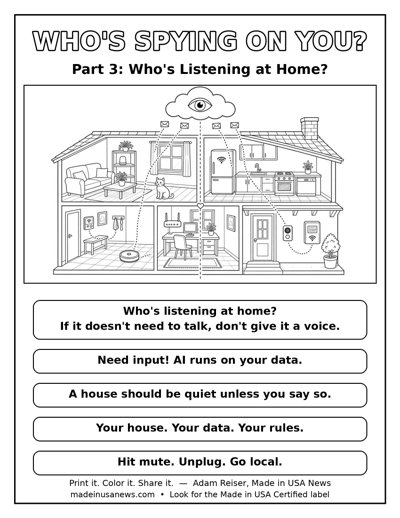
Print and color this page (letter-size PDF)
Color it in with the kids, then talk about which gadgets in your own house are “talking.” Share it with a neighbor.
Next time in “Who’s Spying on You?”: the phone in your pocket, from location tracking to ad IDs and app permissions. Hear more on Made in USA News this Friday.
Sources
- FTC, Internet of Things: Privacy & Security in a Connected World (Jan. 2015); A Look at What ISPs Know About You (Oct. 2021)
- U.S. Energy Information Administration, How many smart meters are installed in the United States?
- Naperville Smart Meter Awareness v. City of Naperville, No. 16-3766 (7th Cir. 2018); EFF, Fourth Amendment applies to smart meter data
- Nebraska Attorney General, Attorney General Hilgers Files Suit Against TCL (Nov. 25, 2026)
- FTC v. Ring, Complaint; Proposed Stipulated Order (2023)
- U.S. Department of Justice, Amazon agrees to $25 million civil penalty over Alexa children’s privacy (2023)
- Sen. Ed Markey, Probe into Amazon Ring reveals new privacy problems (2022)
- Ring, Sunsets Request for Assistance (Jan. 24, 2024); Plans to work with Axon; Community Requests; Ring and Flock cancel partnership (Feb. 12, 2026); Using video end-to-end encryption
- Associated Press, Amazon scraps partnership with surveillance company after Super Bowl ad backlash
- EFF, Amazon Ring’s new indoor surveillance drone is not compatible with privacy (Nov. 16, 2026)
- The Verge, Amazon is taking away the option of not sending voice recordings to the cloud (Mar. 2025); Roomba creator says it will never sell your data (2017)
- TIME, Thousands of Amazon workers listen to Alexa users’ conversations (2019)
- MIT Technology Review, A Roomba recorded a woman on the toilet. How did screenshots end up on Facebook? (2022)
- Carpenter v. United States, 585 U.S. 296 (2018)
- Tools and rights, Amazon: Manage your Alexa voice recordings; Google My Activity; CISA: Home Network Security; Home Assistant; California Consumer Privacy Act
- Other, Part 1: What “Telemetry” Really Means; Part 2: When Your Car Started Spying; Your Smart TV Is a Data-Export Device; Short Circuit (1986) quotes, IMDb