

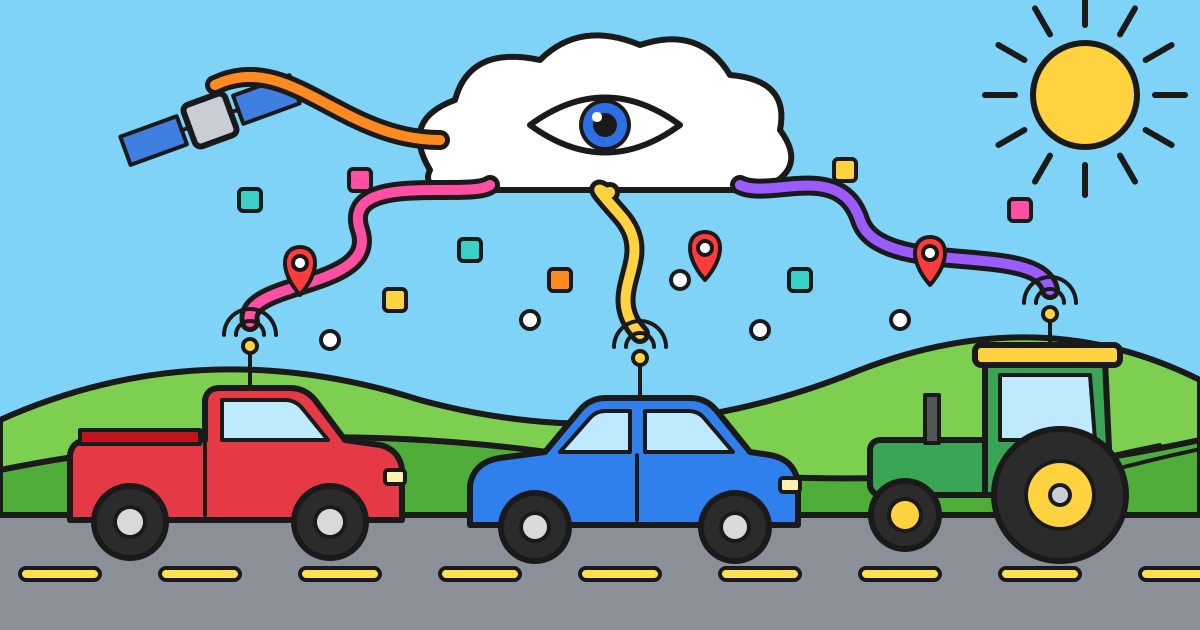
Welcome back to “Who’s Spying on You?” In Part 1 we pulled the lab coat off the word “telemetry.” This time we go out to the driveway, the job site and the back forty. Your car, your work truck and your tractor are computers on wheels. The question is simple: what year did yours start spying, and who is it talking to?
I spent years in aerospace. Telemetry meant something real to us: the data streaming back from Pershing missiles, the B-1B, the F-16 and F-14 and their inertial navigation and measurement units, and the space shuttle. Merriam-Webster still defines telemetry that way. Nobody in that world thought the word would one day describe a minivan reporting how hard Mom hit the brakes on the way to soccer practice. On a consumer vehicle, “telemetry” and “telematics” are technical labels for the same thing: your vehicle collecting information about you and sending it somewhere else.
Your car is a computer on wheels. The only question is who it’s talking to.
How much data are we talking about? Here are the receipts
I don’t want you to take my word for it. Here is what regulators, senators, reporters and researchers have documented, in their own words and numbers.
- Every three seconds. The FTC’s complaint against General Motors and OnStar says that since at least 2018, GM collected precise geolocation data from millions of its Gen10+ OnStar vehicles through a software task that “collected and transmitted precise geolocation data every three seconds, starting from ignition on.”
- Every hard stop, every fast start. According to the same FTC complaint, GM’s Smart Driver feature captured events such as hard braking, hard acceleration, speeding over 80 mph and seat belt use, tied to your VIN, a trip ID, a timestamp and precise location, and sent it to data brokers including LexisNexis and Verisk.
- 130 pages on one driver. In March 2024, Kashmir Hill of The New York Times reported on a Chevrolet Bolt owner whose LexisNexis consumer report ran more than 130 pages and covered 640 trips over six months, with start and end times, distance, speeding, hard braking and rapid acceleration.
- Pennies per car. Senators Ron Wyden and Ed Markey told the FTC in a July 2024 letter that Honda shared data from 97,000 cars with Verisk for $25,920, about 26 cents per car, and that Hyundai shared data from 1.7 million vehicles with Verisk for $1,043,315.69, about 61 cents per car. Your driving habits, sold for less than a cup of coffee.
- “Not enrolled” when you were. The state attorneys general say the OnStar app mistakenly told more than 370,000 drivers they were not enrolled in Smart Driver when they were, and GM was collecting and selling their data.
- The black box under your seat. Federal rules for event data recorders (49 CFR Part 563) list what an EDR records around a crash: vehicle speed, accelerator position, brake on or off, seat belt status and more, plus optional items such as steering input, occupant size classification for the driver and front passenger, and whether the seat is all the way forward. NHTSA has finalized a rule expanding pre-crash recording to 20 seconds, phasing in from September 1, 2028.
- Your phone, copied into the dashboard. Berla, a company whose iVe tool is built for forensic investigators, says in its product datasheet that infotainment and telematics systems “store a vast amount of data such as recent destinations, favorite locations, call logs, contact lists, SMS messages, emails, pictures, videos, social media feeds, and the navigation history of everywhere” the vehicle has been. Plug in or pair your phone once, and pieces of it can stay behind.
- The fine print goes further than you think. When Mozilla’s *Privacy Not Included team reviewed 25 car brands in 2023, all 25 failed. Mozilla found 84% said they can share your personal data, 76% said they can sell it, and 56% said they can share it with government or law enforcement in response to a “request.” Nissan’s privacy policy listed “sexual activity,” Kia’s mentioned “sex life,” and six brands said they can collect “genetic information” or “genetic characteristics.” Mozilla called cars “the worst category of products for privacy” it had ever reviewed.
Who gets your data?
- The automaker. OnStar alone has more than 12 million subscribers worldwide, according to GM. Connected services power navigation, roadside help and over-the-air updates. They also power the data pipeline.
- Insurers, through data brokers. The FTC says GM’s driving data went into consumer reports that insurers used, and that many drivers found out only when they got notices that their coverage was denied or cancelled or their premiums went up. Verisk told Privacy4Cars in 2024 that it no longer receives this data from GM, Honda and Hyundai and no longer sells those reports. In that same 2024 report, The Record found LexisNexis was still marketing its Telematics OnDemand product to insurers, and Kia told The Record that Kia Connect terms let it share basic driving information with LexisNexis to create a driving score.
- Marketers and “partners.” That is the 84% “share” and 76% “sell” in the Mozilla review.
- Government and police. Mozilla found more than half of the car brands said they could hand over data on a simple request. And the forensic tools described above are sold to investigators to pull data straight out of the car.
Your driving habits, sold for less than a cup of coffee.
What year did your vehicle start spying? A timeline
- 1974: GM installs the first commercial event data recorders in select models, according to the Congressional Research Service. These early “black boxes” stored crash data in the car. They did not phone home.
- 1996: Two big changes in one model year. EPA rules made on-board diagnostics (OBD-II) standard on all 1996 and newer cars and light trucks. That is the plug under your dash your mechanic uses. And GM introduced OnStar, which it calls the industry’s first embedded telematics platform: a modem in the car with a direct link back to the company. The FTC’s complaint also dates OnStar to 1996.
- 2006 to 2012: NHTSA writes uniform rules for EDRs. They apply to light vehicles built on or after September 1, 2012 that have an EDR. By 2014, CRS reported that more than 90% of new cars and light trucks sold in the USA had them.
- 2015: The Driver Privacy Act, part of the FAST Act, says EDR data belongs to the vehicle’s owner or lessee (Public Law 114-94, section 24302, as cited by NHTSA).
- 2016 to 2024: GM’s Smart Driver program enrolls millions of drivers, according to the state attorneys general.
- 2018: The FTC says GM’s every-three-seconds location tracking was running on Gen10+ OnStar vehicles “since at least 2018.”
- 2020: Massachusetts voters pass a vehicle Data Access Law that requires telematics data to be available to owners and independent repair shops.
- 2021: Congress passes the Infrastructure Investment and Jobs Act, with section 24220 on impaired-driving prevention technology. More on that below.
- 2024: The New York Times reports on automakers sharing driving behavior with insurers. GM ends its LexisNexis and Verisk partnerships and discontinues Smart Driver.
- 2025 to 2026: The FTC proposes, then finalizes in January 2026, an order against GM and OnStar. In October 2026, 36 attorneys general announce a $220 million settlement with GM.
A rule of thumb from me: if your vehicle has a companion app, a built-in Wi-Fi hotspot, an SOS or assistance button, remote start from your phone, or a “connected services” trial, it has a modem. A modem means it can talk.
Cash for Clunkers: my observation
Here are the facts first. In July and August 2009, the federal Car Allowance Rebate System (CARS), better known as Cash for Clunkers, offered $3,500 or $4,500 toward a new, more fuel-efficient vehicle. According to the GAO, NHTSA counted 677,842 approved transactions. Trade-ins generally had to be less than 25 years old and get 18 miles per gallon or less combined. Dealers had to disable the trade-in’s engine, and the vehicle had to be crushed or shredded.
Now my opinion, and I want to be clear it is my observation, not the government’s stated goal: the stated goals were stimulating the economy and putting more fuel-efficient vehicles on the road. But the effect was that hundreds of thousands of older, simpler vehicles, mostly built before cars were always connected, were destroyed for good and replaced with newer, more connected ones. Those old trucks could be fixed with a wrench and didn’t report to anybody. You can’t buy them back now. They’re gone.
The new laws and rules
The FTC and the states vs. GM
In January 2026, the FTC finalized its order with GM and OnStar. The order bars GM from sharing covered driver data with consumer reporting agencies for five years, and, as TechCrunch reported, requires GM to get consumers’ explicit consent before collecting, using or sharing connected-vehicle data. Then on October 29, 2026, a coalition of 36 attorneys general, including North Carolina’s, announced that GM will pay $220 million. The settlement requires affirmative express consent before collecting or disclosing driving and location data, limits on what GM collects, and dealership training so staff stop signing customers up without their consent. States are still announcing their shares: Oklahoma’s attorney general announced its $4.18 million on Friday, November 20.
Other automakers are reacting. On November 2, Ford launched what it calls a “Privacy Promise,” saying it does not share information about how its customers drive with data brokers, according to TechCrunch. A promise is good. A law is better.
State privacy laws
Your state may already give you rights over vehicle data. California’s Consumer Privacy Act gives residents the right to know, delete and opt out of the sale or sharing of personal information, and the California Privacy Protection Agency fined American Honda $632,500 in March 2025 over how it handled privacy requests. Oregon went further: under HB 3875, its consumer privacy law now covers motor vehicle manufacturers that collect personal data from a consumer’s use of a vehicle, and the Oregon DOJ explains your rights here. In Texas, the attorney general sued Allstate and its Arity subsidiary in January 2025, alleging they collected driving data from more than 45 million Americans through phone apps. Those are allegations, and the case is tied up on appeal after a trial court dismissed it on jurisdiction grounds.
The impaired-driving technology mandate (the so-called “kill switch”)
Section 24220 of the 2021 infrastructure law directs NHTSA to write a safety standard requiring “advanced drunk and impaired driving prevention technology” in new passenger vehicles. The law defines it as a system that can “passively monitor the performance of a driver” to identify possible impairment, and/or passively detect blood alcohol over the legal limit, and “prevent or limit motor vehicle operation” if impairment is detected. That is the accurate description. The statute describes a system in the car watching the driver. It does not describe police shutting your car off remotely.
Where it stands: NHTSA published an advance notice of proposed rulemaking on January 5, 2024. The law set a November 15, 2024 deadline for a final rule, and NHTSA missed it. NHTSA told the NTSB in June 2026 that current systems “have yet to demonstrate the maturity, precision, speed, and reliability” the mandate requires, and it listed privacy and cybersecurity among the open issues. There is no proposed rule yet. On January 22, 2026, the House rejected Rep. Thomas Massie’s amendment to defund section 24220, 164 to 268. My concern is the same as with everything else here: a camera and sensors pointed at the driver are more data. Ask who keeps it, for how long, and who else gets it.
Right to repair for cars and trucks
Massachusetts’ 2020 Data Access Law survived a federal court challenge: in February 2025, Judge Denise Casper ruled for the state. The automakers’ trade group appealed, and the First Circuit heard arguments on February 3, 2026. One telling detail from the trial record: the parties stipulated that Subaru stopped offering its telematics system to Massachusetts buyers of model year 2022 vehicles, and that Subaru vehicles not enrolled in the system “are safe” and comply with federal safety standards. In Congress, the House Energy and Commerce Committee set aside the full REPAIR Act in May 2026 and advanced a narrower bill that, as CollisionWeek reported, omits the telematics access mandate.
Tractors: old iron, new software, and the right to repair
Farmers saw this coming first. In a U.S. PIRG and National Farmers Union survey, 77% of farmers said they had bought older-model equipment to avoid the software in newer equipment. PIRG cites a 1980 John Deere 4440 that sold for $43,500 in Lake City, Minnesota, in April 2019. That’s not nostalgia. That’s a farmer voting with his checkbook for a machine he can fix.
Colorado passed the first agricultural right-to-repair law, HB23-1011, which took effect January 1, 2024 and requires manufacturers to provide parts, software, tools and documentation to owners and independent repair shops. In January 2025, the FTC, Illinois and Minnesota sued Deere, alleging it kept full-function repair software for its dealers; Arizona, Michigan and Wisconsin joined later. On July 8, 2026, the FTC, the five states and Deere filed a joint motion for a settlement order. Deere would have to make dealer-equivalent repair resources available to owners and independent repair shops on “fair and reasonable terms” for 10 years, and pay the states $1 million for costs. Deere neither admits nor denies the allegations, and it agreed to comply while the court decides. As of November 18, 2026, The Dispute Index reported the FTC still listed the case as pending, and it could not find an order entering the settlement.
Fix it yourself. Right to repair is a right worth keeping.
The AI angle: “Need input!”
Remember Johnny 5, the robot in the 1986 movie Short Circuit? His famous line was “Malfunction. Need input.” That’s AI in two words. AI runs on data, and the more it gets, the hungrier it gets. Your vehicle is one of the richest sources of data about you: where you go, when, how fast, who rides with you and who you call on the way. GM says it is building “an agentic AI assistant deeply integrated with GM vehicle systems.” Johnny 5 wanted to read books. Today’s AI wants your commute.
Need input! AI runs on your data, and your car is a firehose.
The plain-English glossary
Telematics
The system that collects data from your vehicle and sends it over a cellular connection. Telemetry plus a phone line.
TCU (telematics control unit)
The modem box in your vehicle. It has its own cellular connection, separate from your phone.
Connected services
The automaker’s brand name for what the TCU does: OnStar, FordPass, Kia Connect and so on. Navigation, roadside help, remote start and, often, data collection.
EDR (event data recorder)
The vehicle’s “black box.” It records a few seconds of data around a crash, such as speed, braking and seat belt use. Under the Driver Privacy Act, that data belongs to the owner or lessee.
OBD-II (on-board diagnostics)
The plug under your dashboard, standard since 1996. Mechanics and inspection stations read trouble codes from it. Insurance “dongles” plug in here too.
Infotainment
The touchscreen: radio, maps, phone pairing. It can keep copies of your contacts, call logs and messages after you pair your phone.
OTA (over-the-air) updates
Software updates sent to your vehicle through its modem. Useful for fixes and recalls. Also a two-way street.
UBI (usage-based insurance)
Insurance priced on how you drive, measured by an app, a plug-in device or your car’s own connection. Sometimes it is a “driving score.”
Data broker
A company that buys, packages and sells information about people. For driving data, think LexisNexis Risk Solutions and, until 2024, Verisk.
Consumer disclosure report
The file a consumer reporting company keeps on you. Under federal credit reporting law, you can ask for yours.
DMS (driver monitoring system)
A camera and sensors that watch the driver’s eyes and head for drowsiness or distraction. A building block for impaired-driving technology.
Print and color this page (letter-size PDF). A pickup, a car and a tractor, all talking to the cloud. Color it in with your kids or grandkids, and ask them: what year did our car start spying?
Reclaim Your Sovereignty: From the Matrix to Off the Grid
Sovereignty, the way we mean it, is simple: you own your vehicle and your data, and you use the rights the law already gives you. No secret legal tricks, no magic paperwork. Just practical, legal steps. Start at the bottom of the ladder and climb as far as you’re comfortable.
- Rung 1 (easy): Find out what your vehicle collects. Enter your VIN in Privacy4Cars’ free Vehicle Privacy Report. It summarizes what your automaker’s public policies say it collects and shares. Then open your vehicle’s privacy or connectivity settings menu and the automaker’s app, and read what is switched on.
- Rung 2: Turn off what you don’t need. Switch off location sharing, “driving score,” “driver feedback” and data-sharing options you never asked for, in the car and in the app. Use Bluetooth for audio only, and say no when the car asks to sync contacts and messages. Before you sell, trade or return a vehicle, or after you drive a rental, delete your phone and saved places from the infotainment system. Re-check after every software update.
- Rung 3: Say no to insurer tracking. Decline usage-based insurance programs, apps and plug-in devices unless you truly want them, and read the terms before you accept a “discount.” Watch for automaker “driving score” programs that can feed insurers. Ask your agent, in writing, whether any vehicle or app data is used to price your policy.
- Rung 4: Request your file. Order your free consumer disclosure report from LexisNexis Risk Solutions. The CFPB’s listing for LexisNexis C.L.U.E. and Telematics OnDemand explains what these reports cover. If something is wrong, dispute it. Credit reporting law gives you that right.
- Rung 5: Use your state privacy rights. If you live in California, Oregon, Texas or one of the other states with a consumer privacy law, send your automaker a request to access, delete and opt out of the sale or sharing of your data. Oregon’s law now expressly covers vehicle makers. Turn on Global Privacy Control in your browser before you visit the automaker’s website.
- Rung 6: Limit or disconnect the telematics unit, legally and honestly. Ask your dealer or the automaker to deactivate connected services on your vehicle, and get the answer in writing. Know the trade-offs: you can lose automatic crash notification and SOS calls, stolen-vehicle tracking, remote recall notices and over-the-air updates. Ford, for example, told TechCrunch that turning off connected services disables features like real-time navigation and built-in roadside assistance. Ask whether deactivation affects your warranty or any features you paid for. Don’t cut wires or pull fuses yourself; on many vehicles the same modules tie into safety systems. And remember: your EDR still records crash data either way, and under federal law that data is yours.
- Rung 7: Choose older or less-connected vehicles and equipment. Many farmers already do. Before you buy, ask: does it have a modem? Can connected services be turned off for good? Can I fix it myself? Be honest about what you give up, because newer vehicles have safety features older ones lack. Pick the trade-off with your eyes open.
- Rung 8: Use and defend your right to repair. Buy from makers that publish repair information and sell diagnostic tools to owners and independent shops. If you farm in Colorado, the state’s ag right-to-repair law is on your side. If you run Deere equipment, watch for the final FTC order and the dealer-equivalent repair access it promises.
- Rung 9 (advanced): Ask your legislators the hard questions. Will you require opt-in consent before any automaker or app sells or shares driving data? Will you ban selling it to insurers and data brokers without that consent? Will you add vehicle makers to our state privacy law, as Oregon did? Will you guarantee owners and independent shops access to their vehicles’ data, as Massachusetts voters did? And on section 24220: what data will impaired-driving systems keep, who gets it, and can it be used against the driver?
For businesses and fleets: your trucks, vans and equipment carry telematics too. Ask every vendor, in writing, what their devices and software send back, to whom, and how to turn it off. That’s the same idea behind the No Phone Home (NPH) plugins my team built for our own software: what goes out is a basic “still here” signal and only what we decide to share.
Your car. Your data. Your rules.
Our Take
For more than 20 years we’ve asked, “Where was it made?” Now we ask a second question: “Who is it talking to?” Check it twice. Support USA makers that respect their customers, look for the Made in USA Certified label, and keep your keys, your data and your right to fix what you own. If you missed it, start with Part 1: What “Telemetry” Really Means. Next in “Who’s Spying on You?”: who’s listening at home, from smart thermostats and meters to Ring, Alexa and Google.
— Adam Reiser, Made in USA News
Sources
- Federal Trade Commission, In the Matter of General Motors LLC, et al., Complaint and Decision and Order, Docket No. C-4828
- TechCrunch, The FTC’s data-sharing order against GM is finally settled (Jan. 14, 2026)
- Washington Attorney General, GM to pay $220M for sharing drivers’ private data (Oct. 29, 2026); Oklahoma Attorney General, Drummond reaches multi-million settlement with GM (Nov. 20, 2026)
- The New York Times, Kashmir Hill, Automakers Are Sharing Consumers’ Driving Behavior With Insurance Companies (Mar. 11, 2024)
- Sens. Ron Wyden and Edward Markey, Letter to the FTC on automaker data sharing (July 26, 2024)
- Mozilla Foundation, *Privacy Not Included, It’s Official: Cars Are the Worst Product Category We Have Ever Reviewed for Privacy (Sept. 6, 2023; archived)
- The Record, Recorded Future News, Data broker shuts down product related to driver behavior patterns (June 11, 2024)
- Berla, iVe datasheet
- Code of Federal Regulations, 49 CFR Part 563, Event Data Recorders; NHTSA, Event Data Recorders final rule (May 18, 2026)
- Congressional Research Service, “Black Boxes” in Passenger Vehicles: Policy Issues (R43651)
- EPA, Do you drive a 1996 or newer car or light truck?; General Motors, OnStar at 30 (Sept. 25, 2026)
- GAO, Auto Industry: Lessons Learned from Cash for Clunkers Program (GAO-10-486)
- Infrastructure Investment and Jobs Act, Public Law 117-58, sec. 24220; NHTSA, Advanced Impaired Driving Prevention Technology ANPRM; NTSB recommendation H-22-022 correspondence; House Roll Call 43 (Jan. 22, 2026)
- Alliance for Automotive Innovation v. Campbell, D. Mass. Memorandum of Decision (Feb. 11, 2025); First Circuit docket No. 25-1262
- CollisionWeek, House Energy and Commerce codifies industry MOUs in place of full REPAIR Act (May 26, 2026)
- Colorado General Assembly, HB23-1011 Consumer Right to Repair Agricultural Equipment
- FTC v. Deere & Company, Joint Motion for Entry of Stipulated Order, No. 3:25-cv-50017 (N.D. Ill.); NAAG case page; The Dispute Index case summary
- U.S. PIRG Education Fund, Why Farmers Need Right to Repair
- State privacy, California Consumer Privacy Act; CPPA Honda decision; Oregon HB 3875 staff summary; Oregon DOJ privacy FAQ; Texas AG v. Allstate and Arity; Texas Data Law Tracker
- Consumer tools, LexisNexis consumer disclosure; CFPB company listing; Privacy4Cars Vehicle Privacy Report; Global Privacy Control
- Other, TechCrunch on Ford’s Privacy Promise (Nov. 2, 2026); Short Circuit (1986) quotes, IMDb; Merriam-Webster, “Telemetry”