

“Made in the USA” was once a promise to consumers. Today, it is becoming a test of national strength.
In a world reshaped by geopolitical tensions, fractured supply chains, and accelerating technological competition, the origin of what America builds is no longer a lifestyle preference—it is a strategic question. Rare earth elements, heavy metals, advanced alloys, and critical components now sit at the heart of AI systems, clean energy, aerospace, and national defense. Yet the uncomfortable truth is this: while the United States may assemble many final products domestically, the materials and processing beneath them often remain opaque, globally entangled, and beyond verification. In the 21st century, sovereignty is no longer defined only by borders. It is defined by control, transparency, and trust across supply chains.
Recent U.S. government actions make this shift unmistakably clear.
The federal focus on critical minerals — particularly processed minerals and their derivative products — signals a strategic recalibration. Mining alone is not enough. Processing, refining, and material transformation are where power concentrates, dependencies form, and vulnerabilities emerge. This is why current policy discussions increasingly frame supply chains as matters of national security rather than trade efficiency. The message is simple but profound: a nation that cannot verify what goes into its defense systems, energy infrastructure, and advanced manufacturing cannot fully defend them. “Made in the USA” is being redefined at the policy level — not as a slogan, but as a capability.
The real choke point isn’t extraction — it’s processing.
Rare earth elements and heavy metals are distributed worldwide, but their refining and separation are highly concentrated and technologically complex. Processing determines purity, performance, and suitability for advanced use. It is also the stage most vulnerable to substitution, mislabeling, and origin washing. A component can cross borders multiple times, be blended with unverified materials, or pass through intermediaries that erase provenance — all before reaching a U.S. factory floor. By the time a final product is labeled “Made in the USA,” the upstream truth may already be lost. This gap between physical production and verifiable knowledge is where modern supply chains quietly fail.
National defense exposes the stakes more clearly than any other sector.
Defense systems are not just collections of parts — they are interdependent material ecosystems. Magnets, sensors, guidance systems, armor alloys, electronics, and energy storage all depend on specific material properties and trusted inputs. This makes national defense not only a materials problem, but a provenance problem. Knowing what a component is made of is inseparable from knowing where it came from, how it was processed, and who handled it. Paper certificates, siloed audits, and after-the-fact inspections were built for a slower, simpler world. They cannot keep up with modern complexity—and they cannot scale to address strategic risk.
And this is where the system truly breaks: fraud scales faster than enforcement.
Globalized supply chains move at digital speed. Fraud, substitution, and misrepresentation exploit that speed. Regulators and inspectors, constrained by manual processes and fragmented records, cannot match it. As volume increases, enforcement does not scale linearly — it falls behind. This creates a dangerous asymmetry: bad actors gain leverage as complexity rises. The only way to close this gap is to change the model entirely. Verification must scale like software. Trust must be embedded continuously, not checked occasionally. Compliance cannot rely on static documents; it must be designed into the infrastructure itself.
This is where platform certification and data tracking become transformative.
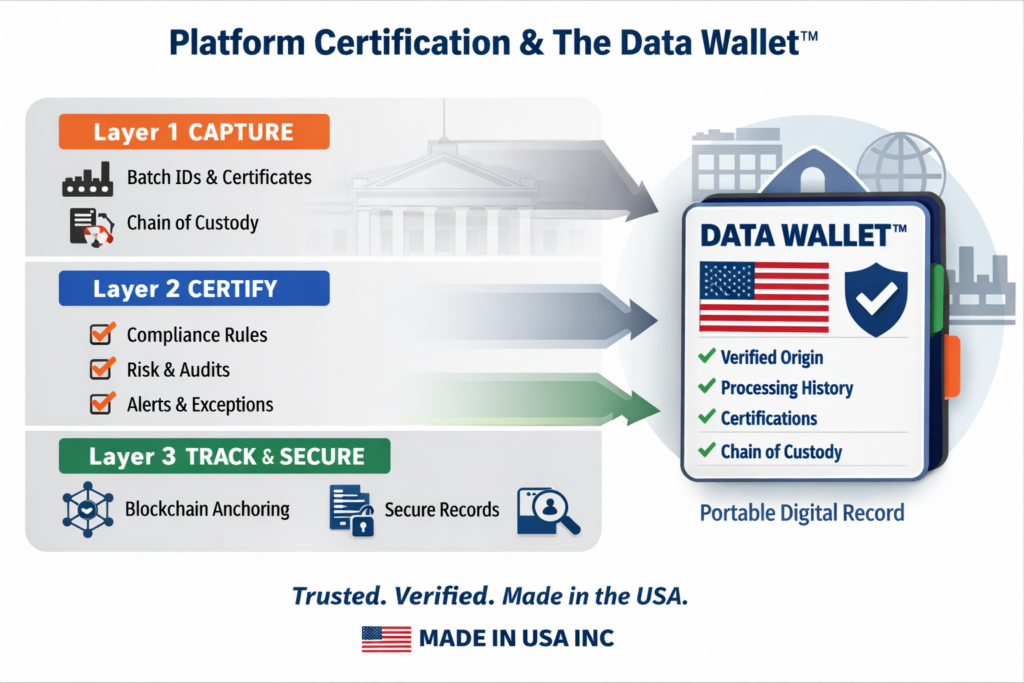
MADE IN USA INC is building the missing infrastructure layer for modern American manufacturing. Instead of relying on fragmented paperwork and one-time claims, the platform introduces continuous, system-level certification — capturing data across processing, custody, compliance, and manufacturing in real time. At the center of this architecture is the Data Wallet™: a secure, portable digital record that travels with a product, holding its verified truth — origin data, processing history, certifications, and chain-of-custody events. By anchoring critical proofs with blockchain technology, the system ensures integrity, auditability, and tamper resistance across parties that do not need to trust one another to trust the data.
This is how “Made in the USA” becomes future-proof.
Not through louder claims, but through stronger systems. Not by looking backward, but by building forward. A verified, data-driven “Made in the USA” standard restores consumer confidence, industry resilience, and national security credibility. Making America great again in this era means leading not only in what we build, but also in how we prove it. Trust, once intangible, is now infrastructure. And infrastructure is how nations win the future.