

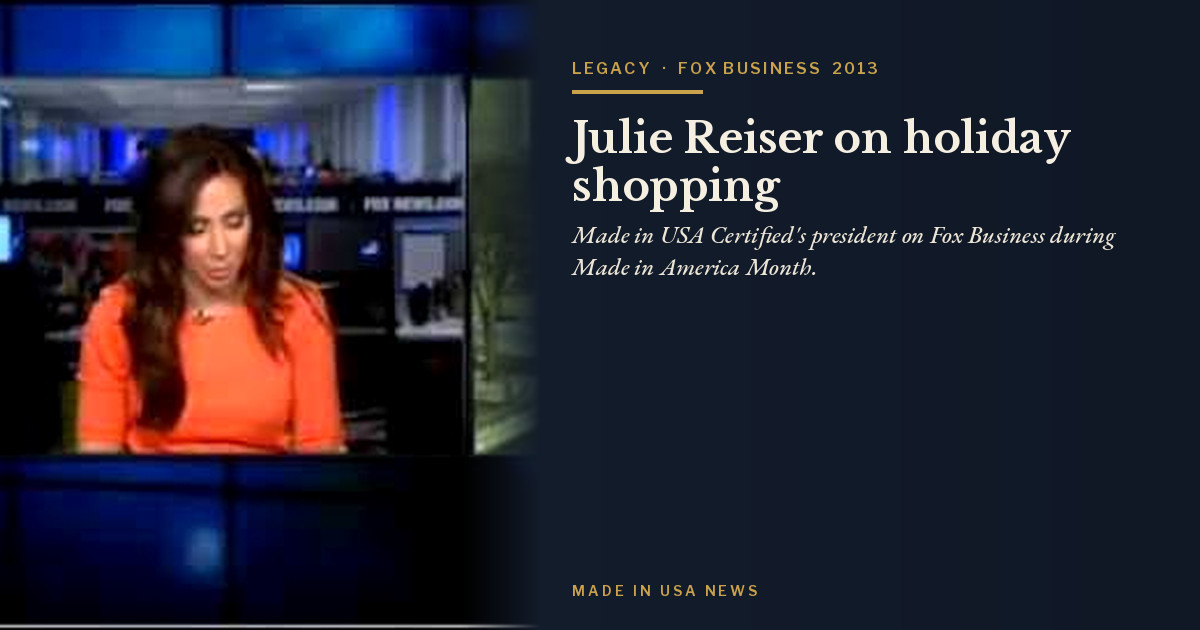
On December 6, 2013, Made in USA Certified president Julie Reiser went on Fox Business from Denver to talk holiday shopping and why, she argued, December was the right month to look for goods made in the United States. The clip was posted to YouTube on December 18, 2013, by the Adam Reiser channel. Reiser appeared with Fox Business anchor Lauren Simonetti.
Reiser opened with a history that is on the federal books: in 1985, President Ronald Reagan issued Proclamation 5424 — Made in America Month, 1985, setting December as Made in America Month, a title used here because it is the official name of the proclamation. She said she wrote about that designation each year around December, and that the 40th president had chosen the busiest retail month of the year on purpose. Simonetti noted the 1980s pressure on U.S. auto and electronics makers from foreign products. Reiser said consumers, not government alone, had to drive a Made in USA movement with their purchases.
She pointed to a then-recent Perception Research Services study, which she said found American consumers willing to pay 60 percent more for goods made in the United States because they believed those goods were safer and of better quality, and she added that millennial shoppers were motivated by a sense of giving back and supporting U.S. jobs. Simonetti, looking at National Retail Federation figures, put average holiday spending around $738 and said the federation’s projection for November and December holiday sales was $62 billion bigger than the prior year. She also noted the tension between shoppers hunting 40 percent discounts and surveys that claimed people would pay more for a U.S. origin. Reiser cited Walmart’s then-announced $50 billion Made in USA initiative as an attempt to balance price and origin, and she argued that if consumers put even half of that $738 toward U.S.-made gifts, the result could be as many as a million new American jobs — a figure she offered on air, not a government forecast verified here.
The interview is a December shopping-season argument from the president of Made in USA Certified, tied to a presidential proclamation that is still on the historical record, and to the consumer-research and retail numbers as they were stated on Fox Business that week.
The video
Credit: julie reiser foxbusiness made in usa certified 12 6 131, posted December 18, 2013, on the Adam Reiser channel. The description identifies Made in USA Certified president Julie Reiser and cites Proclamation 5424 — Made in America Month, 1985. The interview aired on Fox Business on December 6, 2013, with Lauren Simonetti. A related listing also appears on Made in USA News’ Videos page.
Transcript
The text below is from the video’s automatic captions, lightly cleaned for punctuation and speaker labels. The caption track misspells Julie Reiser (“Julie Riser,” “Julie rord”) and garbles the name of her blog and the official title of Reagan’s proclamation. Those names are corrected above from the video description and from the proclamation itself. Automatic captions can still misspeak words.
Lauren Simonetti: Maybe you guys are doing some holiday shopping this weekend. What’s the number — not a lot of days left before Christmas. What is it, the sixth? Okay, the countdown begins. A lot of stores are staying open for 100 hours straight just to get your business. But Julie Reiser is joining us now. You are the president of Made in USA Certified, joining us from Denver, and you say everybody should buy items that are made in America. Welcome to the show. Why is that, Julie?
Julie Reiser: Oh, thank you, Lauren. Great to be here. Well, you know, every year in and around December I write a blog about Made in America Month being proclaimed in 1985 by Ronald Reagan as Made in America Month. I find it so fascinating that our 40th president of the United States, who was president from 1981 to 1989, proclaimed the busiest retail month of the entire year as Made in America Month, and nobody’s really talked about it until recently. I think that now is the time that we really need to take control of our economy. As we’ve seen, our government is completely out of control with the government shutdown. The consumers have the power to turn this economy around, and this is a great month to do it.
Simonetti recalled the 1980s auto and electronics markets and said a cheaper import price, especially from China, was still a cost issue for shoppers. Reiser agreed that imports had pounded the U.S. automobile market in the 1970s, and that Reagan had felt the government needed to protect the Big Three at that time, but she said government could not do it all. “It’s really the consumers that have to drive this movement, this made in America and Made in USA movement, and consumers need to purchase these goods.”
Reiser: Consumers now, according to a recent study that just came out from Perception Research Services — it was just last week — said that American consumers are willing to pay 60% more for made-in-America goods because they do believe that it’s safer, it’s better quality. Plus millennials now, consumer research is showing, are much more motivated to make consumer products that have a feel-good feeling, where they feel like they’re giving back, and buying American supports U.S. jobs.
Simonetti, citing the National Retail Federation, put average holiday spending “upwards of $700” and later “$738,” and said the federation’s projection for November and December holiday sales was $62 billion bigger than the prior year. She called the tension with a 60% price premium “a little conflicting.” Reiser agreed it was conflicting, and pointed to “Walmart with their $50 billion made in America initiative” as an attempt to offer low prices and a U.S. origin at the same time. “If consumers purchase half of the $738 that the retail federation is saying that American consumers in general spend during the holidays, we could create up to a million new American jobs, and that’s pretty powerful.”
Simonetti closed by putting responsibility on companies as well as consumers, “the Walmarts out there,” to make supply-chain arrangements that could produce more U.S. goods at appealing prices. She thanked Reiser and said she had read her blog. Reiser wished viewers happy holidays.