
And behind every false one, an American worker who lost the sale.
By Michelle Tan, Made in USA News
At some point today, between the second burger and the moment somebody suggests moving the cornhole boards into the shade, pick up the nearest object and turn it over.
The cooler. The folding chair that has survived four presidencies. The spatula. Somewhere on it there is a small line of text telling you where it came from, and there is a reasonable chance that line is doing more work than the person who wrote it can support.
That is a strange way to begin a Labor Day column. Stay with me, because it ends where it should.
The people we are actually thanking
Today we honor the people who make things. Machinists and welders. Line workers and quality inspectors. The farmers who grow it, the drivers who move it, the warehouse crews who load it at four in the morning, and the small-business owners who sign the front of the paycheck instead of the back.
Generations of Americans have taken up the dignity of hard work and the responsibility of providing for people they love. What they built was never only goods and services. It was strong families, steady communities, and a shot at something better for the next kid in line.
That is why “Made in USA” carries weight. It is not decoration. It is a claim about human beings — that somewhere upstream of your shopping cart, a person in this country put in a day and got paid for it.
Which is exactly why it matters whether the claim is true.
The four most expensive words in American retail
The Federal Trade Commission does not treat “Made in USA” as a vibe. Under the Made in USA Labeling Rule, an unqualified claim means final assembly happens here, all significant processing happens here, and all or virtually all components are sourced here. Only negligible foreign content survives that test.
Most companies that get in trouble are not cartoon villains. They fail at the third part. Parts come in from overseas, final assembly happens in Ohio, and somebody decides that is close enough for a flag on the box. The FTC’s position is unambiguous: domestic final assembly, by itself, does not earn the claim.
Some cases are less subtle. In 2022 the FTC took action against Utah apparel company Lions Not Sheep Products and its owner, Sean Whalen. According to the agency’s complaint, the company sold clothing imported from China and elsewhere, removed the tags disclosing foreign origin, and printed “Made in USA” at the neck instead. The complaint also alleged Whalen had posted a video explaining that he could conceal the shirts’ Chinese origin by ripping out the origin tags and replacing them. The Commission voted 5-0 to finalize the order, which carried a judgment of $211,335 and required the company to stop making the claims and disclose its foreign production. The following year, the FTC returned more than $176,000 to the consumers who had been deceived.
Same shirt. New story. And American shoppers paid the premium for a promise nobody kept.
Enforcement in 2026 has been anything but quiet. A March executive order made origin claims a federal priority. The FTC ran a coordinated sweep in April and sent another round of warning letters in July, including one over a “Made in Texas” claim on goods that appeared to have been imported. The maximum civil penalty runs to $53,088 per violation, and the agency counts each mislabeled listing separately — which adds up quickly for a company that repeats the claim on two hundred product pages.
If your reaction to all this is good, hold that thought, because it is the whole argument.
This is a labor story, not a compliance story
Here is what a false label actually does.
Two companies make a similar product. One of them tools up in Michigan, hires locally, pays domestic wages, buys American steel, and prices accordingly. The other imports nearly everything, snaps it together in a rented bay, prints a flag on the carton, and undercuts the first company by thirty percent.
The shopper who wanted to support American workers buys the second one. She did everything right. She read the label, she paid a premium, she felt good about it — and every dollar of that premium went to the company that lied.
The American worker in that story is not an abstraction. He is the guy in Michigan whose line ran four days a week instead of five. Counterfeit origin claims do not just deceive consumers. They transfer money away from the exact people this holiday exists to honor, and they do it using those people’s reputation as the sales pitch.
That is why verification is not paperwork. It is how gratitude reaches the right address.
Where the technology comes in
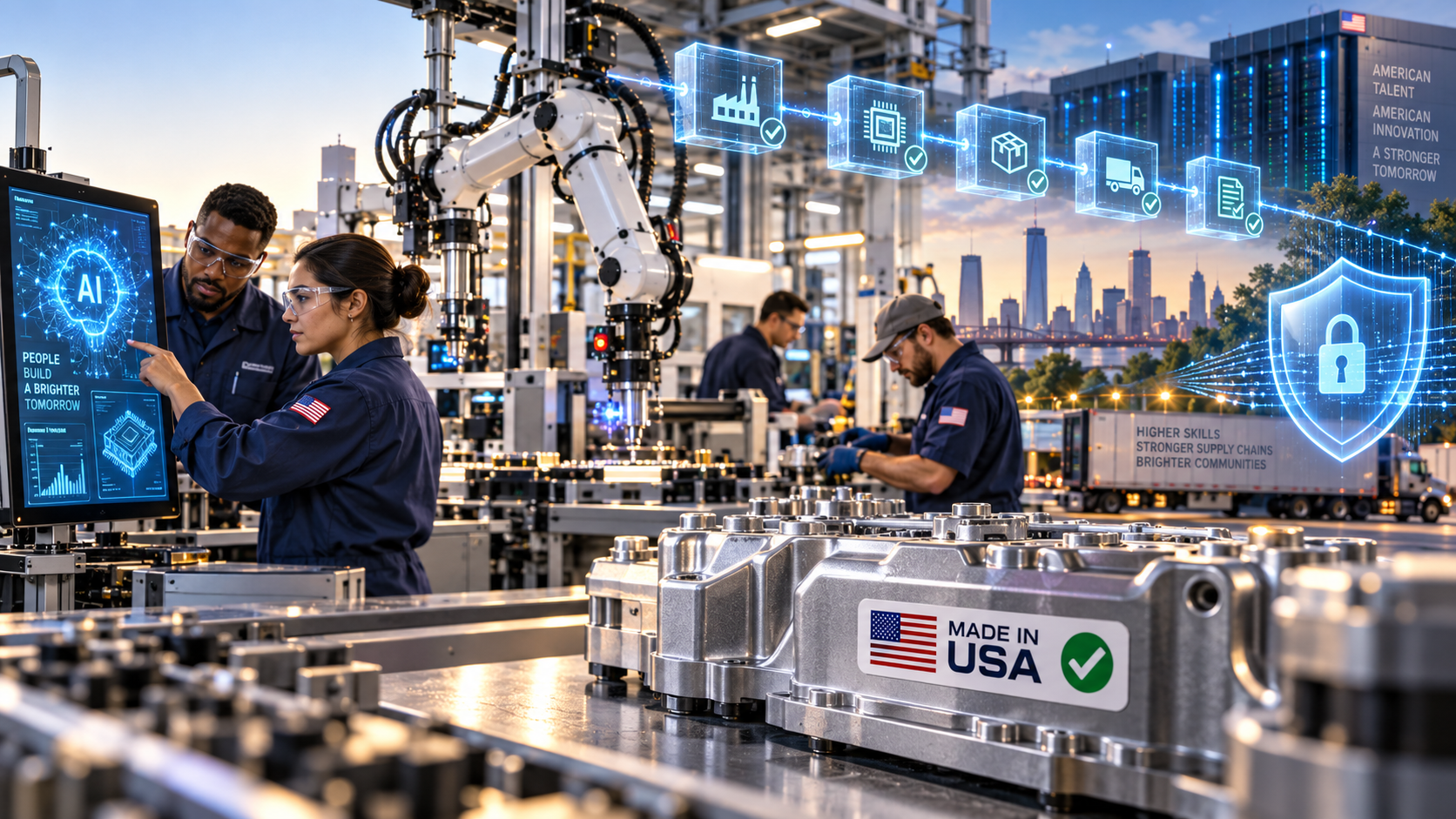
Automation and AI are rearranging the workplace, and the honest worry underneath that is not that machines will do the work. It is that the human contribution will become invisible — buried so deep in a supply chain that nobody can see it, price it, or thank it.
Provenance technology answers exactly that worry. The same infrastructure that proves a product’s components and processing are domestic can also make the human work behind it legible: which facility, which certification, which verified supplier, documented at the moment it happens rather than asserted in marketing copy afterward.
Used this way, technology does not replace the worker in the story. It puts his name back on it. The March executive order pointed in this direction too, contemplating that online marketplaces bear responsibility for verifying the origin claims third-party sellers post. Trust, checked at the point of sale.
We should also keep building the workforce that fills those facilities — real investment in skilled trades and technical education, and permission for young people to aspire to be machinists, technicians, engineers, and founders. Meaningful work has never been only a paycheck. It is independence, and the satisfaction of pointing at something and saying you made it.
What to do with this at the grill
You have heard that every purchase is a vote. It is a good line, and it is only half true, because a vote only counts if somebody is checking the ballots.
So make it count. Look for claims a company can actually substantiate. Notice the difference between “Made in USA” and the softer wording — assembled here, designed here — which is often perfectly honest and tells you something useful. Reward the manufacturers who publish their supply chains instead of the ones who publish a flag. Ask a question or two. Companies doing the real thing love that question, because it is the one that finally distinguishes them.
Then put your phone down and go back to the potato salad. It is a holiday.
But tomorrow, and every day after, remember what that little line of text is supposed to mean. Behind an honest label stands an American worker, an American family, and an American community. Behind a false one stands the same worker, holding an empty order book, while somebody else spends the credit for his work.
To everyone who builds our homes, grows our food, moves our goods, cares for our families, and manufactures what we depend on: thank you. You are the heart of this country, and you deserve a label that tells the truth about you.
Happy Labor Day.
Sources
FTC: Complying with the Made in USA Standard
FTC: Action against Lions Not Sheep for bogus Made in USA labels (May 2022)
FTC: Final order against the “Made in USA” offender who ripped out Made in China tags (July 2022)
FTC case file: Lions Not Sheep, Matter 222-3023
16 C.F.R. § 1.98, current civil penalty amounts