

What a barrel factory in Alabama, a chatbot at Amazon, and the U.S. Treasury all have in common
Made In USA News
Printing “Made in USA” on a label costs about a penny.
Proving it costs rather more. You need a bill of materials, supplier attestations, sourcing documents, and a paper trail that survives an FTC inquiry. One cent to say it. A great deal more to mean it.
Hold that gap in your head, because it’s about to explain three things that look unrelated: why your shopping app quietly buries American-made products, why the U.S. Treasury has suddenly taken an interest in reading smart contracts, and why a barrel factory in Alabama closed this year.
They are the same story. The story is that claims have gotten cheap and proof hasn’t, and the entire economy is starting to notice.
The reshoring reality check
The political message is loud. The White House proclaimed July 19–25, 2026 as “Made in America Week.” The administration has layered new tariffs on steel, aluminum, copper, and 60 trading partners this year alone.
The data is more stubborn.
Kearney’s 2026 Reshoring Index came in at −91, up from −115 the year before. Both numbers need a translation, because the index gets misread constantly. It measures the year-over-year change in the ratio of manufactured imports from low-cost Asian countries to domestic manufacturing output. A negative reading means that ratio grew.
So −91 doesn’t mean reshoring is happening slowly. It means imports still outpaced domestic output — just by less than last year.
That’s progress in the second derivative. It is not yet progress.
Private manufacturing construction spending peaked in March 2025 and has fallen since. Real plants are still closing: Alabama Cooperage, which made white oak barrels for Jack Daniel’s, shut its Trinity facility this year. Ford’s chief executive has pointed to a skilled-labor shortage, not tariff policy, as the thing standing between ambition and output. You cannot tariff your way into welders.
There is one unambiguous bright spot and it is a large one. SK Hynix broke ground on a $4 billion AI-chip packaging plant in Indiana, with high-bandwidth memory production slated for 2029 — the first HBM ever made in the United States. CHIPS Act-backed fabs in Arizona and Texas are shipping leading-edge chips today.
The honest summary: industrial policy is working where the government writes checks and the national-security case is obvious. It is not yet working broadly.
But now return to the penny, because tariffs did something to it.
A tariff raises the value of being American. It does absolutely nothing to the cost of saying you’re American. Sixty trading partners’ worth of new duties is sixty new reasons to print a label, and the label still costs a cent.
Policy that inflates the value of a claim without touching the price of faking it has exactly one predictable output. More claims than anyone can check.
The chatbots know
Which brings us to the most quietly damning study of the year.
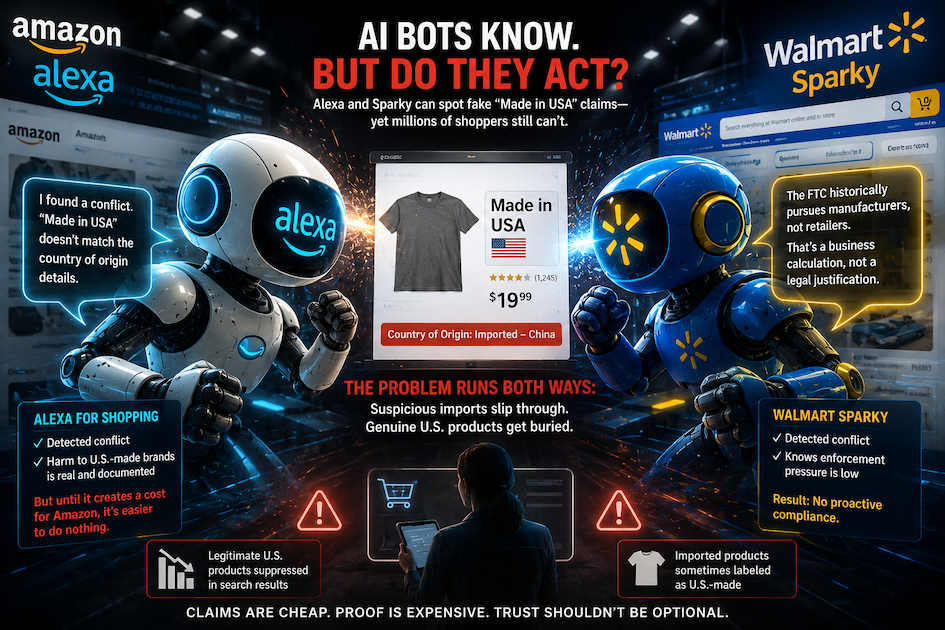
In July 2026, Columbia Law School’s Center for Law and the Economy — the policy center led by former FTC chair Lina Khan — published its first paper. Researchers, including former FTC chief technologist Erie Meyer, pointed Amazon’s Alexa for Shopping and Walmart’s Sparky at listings where a prominent “Made in USA” badge contradicted country-of-origin details further down the same page.
The assistants noticed. Every time.
Then the researchers asked the obvious follow-up: if you can see it, why doesn’t anything happen?
Neither claimed a technical limitation. Walmart’s Sparky observed that the FTC has historically pursued manufacturers rather than retailers, which has kept the pressure to build proactive compliance systems low — and then, unprompted, graded its own answer: that’s a business calculation, not a legal justification.
Amazon’s Alexa was blunter. The harm to U.S.-made brands, it told researchers, is real and documented — but until that harm creates a financial, regulatory, or reputational cost for Amazon specifically, it remains easier to do nothing.
A note on what that is and isn’t. These are generated chatbot outputs quoted in a research paper, not corporate statements, and treating Alexa as Amazon’s press office would be a category error. The finding is the capability. As Meyer put it, the study lets you prove, rather than merely suspect, that a data gap was a design choice.
The researchers also found the problem runs both ways. The agents didn’t just wave through suspicious imports; they suppressed legitimate American-made listings in search results and, in at least one case, marked imported T-shirts as U.S.-made inside Amazon’s own comparison chart.
Amazon says country-of-origin information appears on product pages when available, that it’s working to improve visibility and accessibility, and that it acts against sellers who violate marketplace policies. The FTC had already asked both retailers to police third-party sellers.
Set the positioning aside and the architecture is clean.
An honest manufacturer faces the FTC’s “all or virtually all” standard: essentially every component domestic, documented, and provable on demand. A dishonest seller faces a penny. The platform in the middle can tell them apart and has no particular reason to. And enforcement lands on the manufacturer, not on the channel distributing the claim.
That isn’t a fraud problem. It’s an incentive structure, and it’s performing exactly as designed.
No sticker fixes it. No self-certification page fixes it. The only thing that changes the math is making the claim checkable by machine, at the speed the machines already run.
The dollar has this problem too, and it’s older
Now the part that seems like a different article and isn’t.
America’s most successful export has never once appeared in a trade deficit chart. It’s the dollar, and we’ve been shipping it abroad since 1948.
For seventy years it went out the way you’d mail cash in an envelope. The eurodollar market — dollars deposited outside the United States, which London banks beginning with Midland in 1955 learned to lend at a profit — grew into a system measured in the trillions that nobody has ever counted precisely. No consolidated ledger exists. The Bank for International Settlements reconstructs it from cross-border banking statistics and researchers argue about the residuals.
Sit with that for a second. The largest dollar market on earth, and after seven decades the number is still an estimate with commas in it.
That’s what happens when you export a claim without exporting the proof. It scales beautifully. You just can’t see it, which becomes everyone’s problem the moment it seizes up — as it did in March 2020, when the Federal Reserve had to backstop a market it could not measure, generously, because generosity is what you do when you can’t see the exposure.
Stablecoins are the same export in a different envelope. This one has a tracking number.
A dollar-backed stablecoin is still a dollar held by someone who never touched a U.S. bank. But its supply, issuance, redemptions and holder concentration sit on a public ledger, updated continuously, readable by anyone. No permission. No reporting lag. No reconstruction from residuals. Total supply now runs above $300 billion.
America has been exporting dollars since 1948. What it has recently started exporting is proof.
Treasury just made “prove it” a legal requirement
The GENIUS Act, which regulates U.S. dollar stablecoins, takes effect on the earlier of January 18, 2027 or 120 days after federal regulators finalize implementing rules.
But the sentence that should interest manufacturers isn’t in the statute. It’s in Treasury’s implementation proposal for Section 3, published August 18, 2026.
For certain foreign-issued stablecoins, a U.S. digital-asset service provider may need a reasonable basis to conclude that the issuer has the technological capability to comply with lawful orders — and will comply with them. A corporate promise may not be enough. Treasury contemplates reasonable due diligence, and asks whether technical review, including examination of smart contracts, ought to be part of it.
Read that with a manufacturer’s eyes.
The federal government is proposing that a claim about capability must be independently checkable, possibly by inspecting the code, rather than accepted as an assertion in a document.
That is the “Made in USA” problem, restated as financial regulation, with a deadline on it.
And the stablecoin industry is currently discovering how far a document actually gets you. In August 2026, KPMG U.S. issued an unqualified opinion on Tether International’s 2025 financial statements — the issuer’s first full audit, showing reserves exceeding liabilities by $6.814 billion at year-end. A real milestone, and a real step past point-in-time attestations.
It is also an opinion covering December 31, 2025, announced in August 2026, on a report that hasn’t been published.
Nobody’s accusing anyone of anything. The point is narrower and more useful: token supply updates every few seconds, and the strongest available assurance about what backs it updates annually and arrives as a summary. The best paperwork in the industry runs on a different clock than the thing it describes.
Which is also true of a bill of materials.
So what does a penny’s worth of proof look like?
The interesting question is no longer “how do we certify this?” It’s “how does a machine check it at 3 a.m. without asking anyone?”
Made In USA Inc (OTC: USDW) has spent nearly three decades in origin certification and rebuilt that business around exactly that question. The architecture runs in layers.
A verification and compliance engine, Veritize, evaluates real-world manufacturing events — a completed production run, a sourcing document, a facility audit — before anything reaches a ledger. That ordering matters, and it answers the oldest objection to blockchain provenance: an immutable record of a false claim is just a false claim you can no longer fix.
A Data Wallet attaches the verified record to the individual product rather than the company, so provenance travels with the item.
Records anchor across public and private XRP Ledger instances and Hyperledger frameworks — public chains for tamper-evident, publicly auditable authenticity, private chains for commercial data manufacturers reasonably don’t want competitors reading — with IoT-enabled ERP integration and hardware security modules.
And in March 2026 the company published an AI-ready verification standard: a machine-readable format built so shopping agents, marketplaces and compliance platforms can validate an origin claim automatically, in real time, instead of parsing a label an assistant is free to ignore.
The split between public and private anchoring is the part worth understanding, because it’s where the argument in this article gets applied to the company making it. Records written to the public XRP Ledger are readable by anyone with a ledger explorer and no relationship to the company — that is the whole point of putting them there. Commercial detail stays on private instances, where a competitor can’t read it. An authenticity claim a stranger can check; a supplier contract they can’t.
That division is the standard this piece has been arguing for throughout, and it’s a fair one to hold any provenance vendor to, this one included. The right question to ask is never whether a company describes its system as verifiable. It’s whether it will hand you the account address and let you look.
The goal is to make “Made in USA” a queryable data object rather than a marketing claim — the same shift the GENIUS Act is forcing onto the word “backed.”
The through line
Three industries, one problem, arriving at once.
The eurodollar showed what happens when you scale a claim faster than anyone’s ability to verify it: seven decades on, the number is still a shrug, and the Fed is still the backstop for a market it can’t see.
Tariff policy has raised the value of an origin claim without touching the cost of fabricating one, which reliably produces more claims than the system can adjudicate.
And AI shopping agents have quietly become the arbiters of which claims consumers ever see — with, per Columbia, the technical ability to police them and no particular incentive to.
Each is a story about informal trust running out of road at internet speed. A reserve-currency reputation. A country-of-origin label. A retailer’s word. The replacement isn’t a better sticker or a stronger promise. It’s a record something else can verify without asking permission.
Finance has a deadline. January 2027 is when “can you prove it, mechanically?” stops being a philosophical question and becomes a compliance requirement.
Manufacturing has no such date. It has tariffs, a strict FTC standard most sellers ignore, and a pair of chatbots that know exactly what’s going on and have said so out loud.
Which of those turns out to be the stronger forcing function is the thing worth watching.
What to watch
Late October 2026 — comment deadline on Treasury’s Section 3 proposal. How “reasonable due diligence” gets defined will set a template, and templates travel between industries.
Between now and January — final GENIUS rules from the OCC, Federal Reserve, FDIC and NCUA, especially the required format of reserve reporting. Machine-readable versus PDF is not a small distinction.
January 18, 2027 — GENIUS effective date.
Any FTC action against a platform rather than a manufacturer. Sparky named this as the load-bearing assumption. One case against a distributor changes the calculation overnight.
Quarterly — Kearney’s index and Census manufacturing construction spending, read correctly. Second-derivative improvement is not reshoring.
July 18, 2028 — the GENIUS distribution prohibition takes effect, and issuer verification stops being optional for every U.S. exchange and payment processor.
A penny built this problem. It’s going to take considerably more than that to unbuild it. But for the first time, the tooling and the deadline are showing up in the same decade.
Michelle Tan 09/01/2026
Made In USA News is affiliated with Made In USA Inc (OTC: USDW), which is discussed in this article. This article is for informational purposes only. It is not an offer to sell or a solicitation of an offer to buy any security, and it is not investment, legal, or tax advice. Statements regarding future capability, adoption, regulation, or market development are forward-looking and subject to risks and uncertainties; actual results may differ materially. Figures are drawn from company disclosures, regulatory filings, and published research as of September 1, 2026. Company-described technical capabilities are identified as such and have not been independently verified.